类似于 kylin 的 ExecMan,bthread::ExecutionQueue 提供了异步串行执行的功能。ExecutionQueue 的相关技术最早使用在 RPC 中实现多线程向同一个 fd 写数据,在 r31345 之后加入到了 bthread。
消息传递与竞争消除
在多核并发编程领域,Message passing 作为一种解决竞争的手段得到了比较广泛的应用。它按照业务依赖的资源将逻辑拆分成若干个独立 actor,每个 actor 负责对应资源的维护工作。当一个流程需要修改某个资源的时候,就转化为一个消息发送给对应 actor,这个 actor(通常在另外的上下文中)根据命令内容对这个资源进行相应的修改,之后可以选择唤醒调用者(同步)或者提交到下一个 actor(异步)的方式进行后续处理。
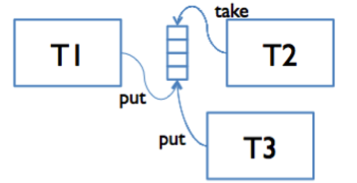
ExecutionQueue 和 mutex 都可以用来在多线程场景中消除竞争。相较 mutex,使用 ExecutionQueue 的优点是任务按提交顺序串行执行,执行任务时无需加锁、也不存在锁竞争;但缺点也同样明显:所有任务只能串行执行,单个耗时较长的任务会拖慢后续所有任务。
不考虑性能和复杂度,理论上任何系统都可以只使用 mutex 或者 ExecutionQueue 来消除竞争。但是在复杂系统的设计上,建议根据不同的场景灵活决定如何使用这两个工具。总之,多线程编程没有万能的模型,需要根据具体的场景,结合丰富的 profiling 工具,最终在复杂度和性能之间找到合适的平衡。
特别指出一点,Linux 中 mutex 无竞争的 lock/unlock 只需要几条原子指令,在绝大多数场景下的开销都可以忽略不计。
创建队列:execution_queue_start
// Iterate over the given tasks
//
// Example:
//
// #include <bthread/execution_queue.h>
//
// int demo_execute(void* meta, TaskIterator<T>& iter) {
//     if (iter.is_stopped()) {
//         // destroy meta and related resources
//         return 0;
//     }
//     for (; iter; ++iter) {
//         // do_something(meta, *iter)
//         // or do_something(meta, iter->a_member_of_T)
//     }
//     return 0;
// }
template <typename T>
class TaskIterator;

// Start a ExecutionQueue. If |options| is NULL, the queue will be created with
// default options.
// Returns 0 on success, errno otherwise
// NOTE: type |T| can be non-POD but must be copy-constructible
template <typename T>
int execution_queue_start(
        ExecutionQueueId<T>* id,
        const ExecutionQueueOptions* options,
        int (*execute)(void* meta, TaskIterator<T>& iter),
        void* meta);
创建的返回值是一个 64 位的 id,相当于 ExecutionQueue 实例的一个弱引用,可以 wait-free 地在 O(1) 时间内定位一个 ExecutionQueue。你可以到处拷贝这个 id,甚至可以放在 RPC 中,作为远端资源的定位工具。你必须保证 meta 的生命周期,在对应的 ExecutionQueue 真正停止前不会释放。
停止队列:execution_queue_stop 与 execution_queue_join
// Stop the ExecutionQueue.
// After this function is called:
//  - All the following calls to execution_queue_execute would fail immediately.
//  - The executor will call |execute| with TaskIterator::is_queue_stopped() being
//    true exactly once when all the pending tasks have been executed, and after
//    this point it's ok to release the resource referenced by |meta|.
// Returns 0 on success, errno otherwise
template <typename T>
int execution_queue_stop(ExecutionQueueId<T> id);

// Wait until the stop task (Iterator::is_queue_stopped() returns true) has
// been executed
template <typename T>
int execution_queue_join(ExecutionQueueId<T> id);
stop 和 join 都可以多次调用,都会有合理的行为。stop 可以随时调用,而不用担心线程安全性问题。
和 fd 的 close 类似,如果 stop 不被调用,相应的资源会永久泄露。
安全释放 meta 的时机:可以在 execute 函数中收到 iter.is_queue_stopped() == true 的任务的时候释放,也可以等到 join 返回之后释放,注意不要 double-free。
任务选项:TaskOptions
struct TaskOptions {
    TaskOptions();
    TaskOptions(bool high_priority, bool in_place_if_possible);

    // Executor would execute high-priority tasks in the FIFO order but before
    // all pending normal-priority tasks.
    // NOTE: We don't guarantee any kind of real-time as there might be tasks still
    // in process which are uninterruptible.
    //
    // Default: false
    bool high_priority;

    // If |in_place_if_possible| is true, execution_queue_execute would call
    // execute immediately instead of starting a bthread if possible
    //
    // Note: Running callbacks in place might cause the dead lock issue, you
    // should be very careful turning this flag on.
    //
    // Default: false
    bool in_place_if_possible;
};

const static TaskOptions TASK_OPTIONS_NORMAL = TaskOptions(/*high_priority=*/ false, /*in_place_if_possible=*/ false);
const static TaskOptions TASK_OPTIONS_URGENT = TaskOptions(/*high_priority=*/ true, /*in_place_if_possible=*/ false);
const static TaskOptions TASK_OPTIONS_INPLACE = TaskOptions(/*high_priority=*/ false, /*in_place_if_possible=*/ true);
提交任务:execution_queue_execute
// Thread-safe and Wait-free.
// Execute a task with default TaskOptions (normal task);
template <typename T>
int execution_queue_execute(ExecutionQueueId<T> id,
                            typename butil::add_const_reference<T>::type task);

// Thread-safe and Wait-free.
// Execute a task with options. e.g
// bthread::execution_queue_execute(queue, task, &bthread::TASK_OPTIONS_URGENT)
// If |options| is NULL, we will use default options (normal task)
// If |handle| is not NULL, we will assign it with the handler of this task.
template <typename T>
int execution_queue_execute(ExecutionQueueId<T> id,
                            typename butil::add_const_reference<T>::type task,
                            const TaskOptions* options);
template <typename T>
int execution_queue_execute(ExecutionQueueId<T> id,
                            typename butil::add_const_reference<T>::type task,
                            const TaskOptions* options,
                            TaskHandle* handle);
high_priority 的 task 之间的执行顺序也会严格按照提交顺序,这点和 ExecMan 不同,ExecMan 的 QueueExecEmergent 的 AsyncContext 执行顺序是 undefined。但是这也意味着你没有办法将任何任务插队到一个 high priority 的任务之前执行。
开启 in_place_if_possible,在无竞争的场景中可以省去一次线程调度和 cache 同步的开销。但是可能会造成死锁或者递归层数过多(比如不停地 ping-pong)的问题,开启前请确定你的代码中不存在这些问题。
取消任务:execution_queue_cancel
/// [Thread safe and ABA free] Cancel the corresponding task.
// Returns:
//  -1: The task was executed or h is an invalid handle
//  0: Success
//  1: The task is executing
int execution_queue_cancel(const TaskHandle& h);
返回非 0 仅仅意味着 ExecutionQueue 已经将对应的 task 递给过 execute,真实的逻辑中可能将这个 task 缓存在另外的容器中,所以这并不意味着逻辑上的 task 已经结束,你需要在自己的业务上保证这一点。